
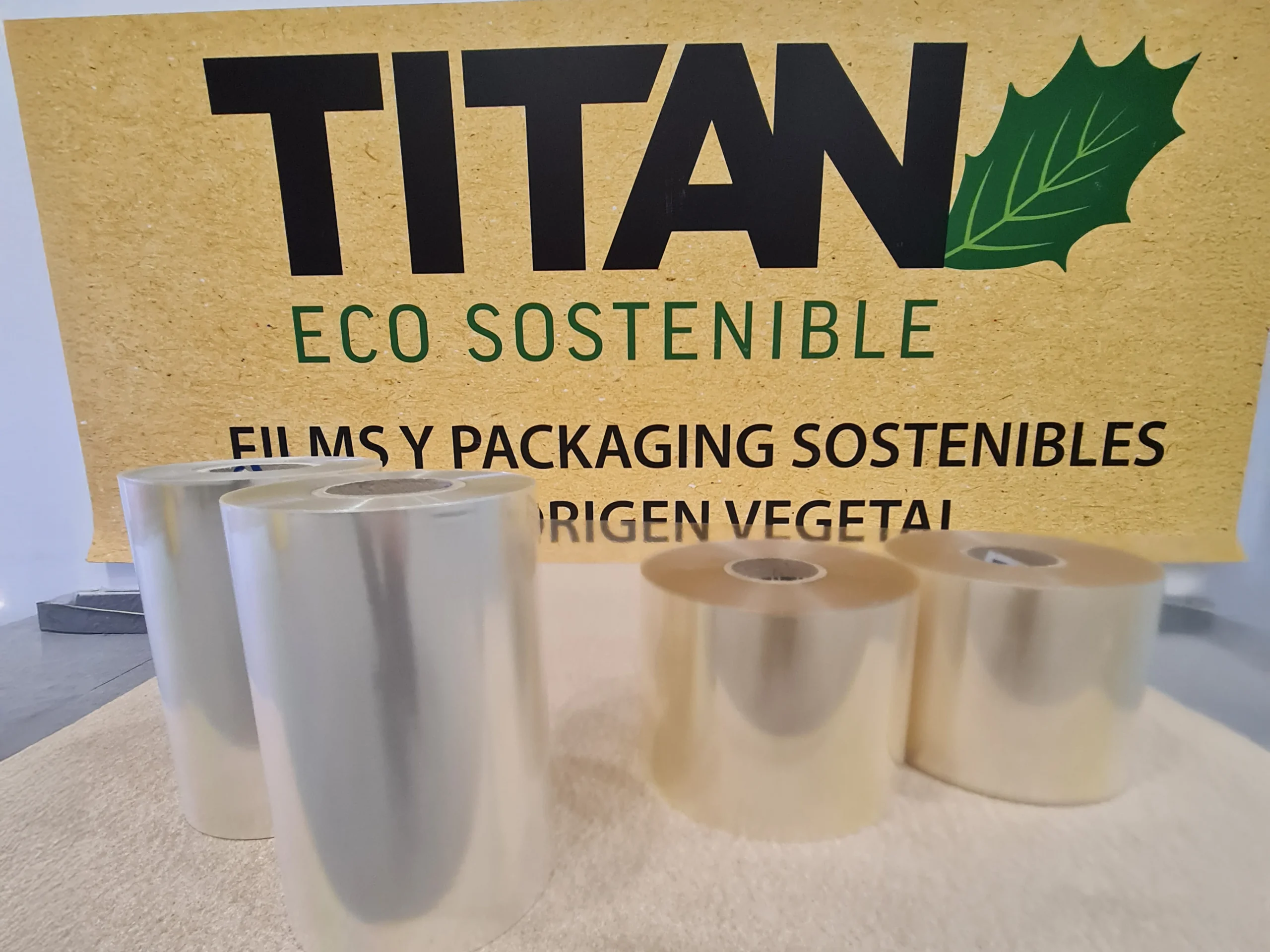

I’m Biodegradable,
just like you!
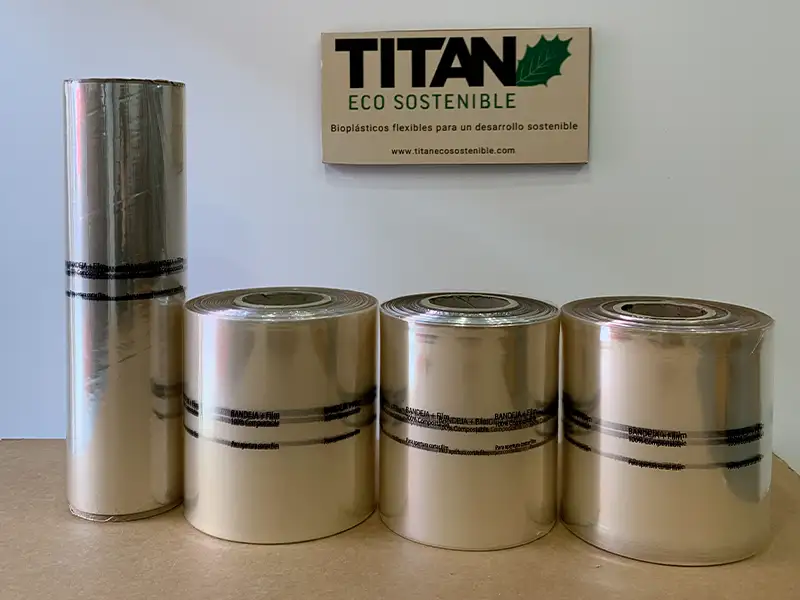
Flexible and compostable packaging: Innovation for sustainable packaging – EN13432 certification
Personalized advice
- We adapt to the needs of each customer offering customized solutions in sizes and printing
- We guarantee the compatibility of our films with each customer’s processes and machinery by offering precise, results-oriented technical advice.
Why choose compostable packaging materials?
- Safe food preservation: . Bioplastics reduce the migration of unwanted substances into food, minimizing the release of contaminants compared to fossil food plastics.
- Aligned with EU legislative constraints:
Bioplastics are an alternative to conventional plastics, designed to reduce the environmental impact associated with petroleum-derived plastic materials.The EU has developed a regulatory framework for Bioplastics as part of its circular economy strategy and its commitment to sustainability:
-European Green Deal
– Action Plan for the Circular Economy
– Bioeconomy Strategy. - Aligned with the social concerns of European consumers, who demand more sustainable food packaging solutions.
- Green marketing They allow brands to differentiate themselves and strengthen their green positioning by attracting environmentally conscious consumers.
What are the different use cases for plastic-free packaging?
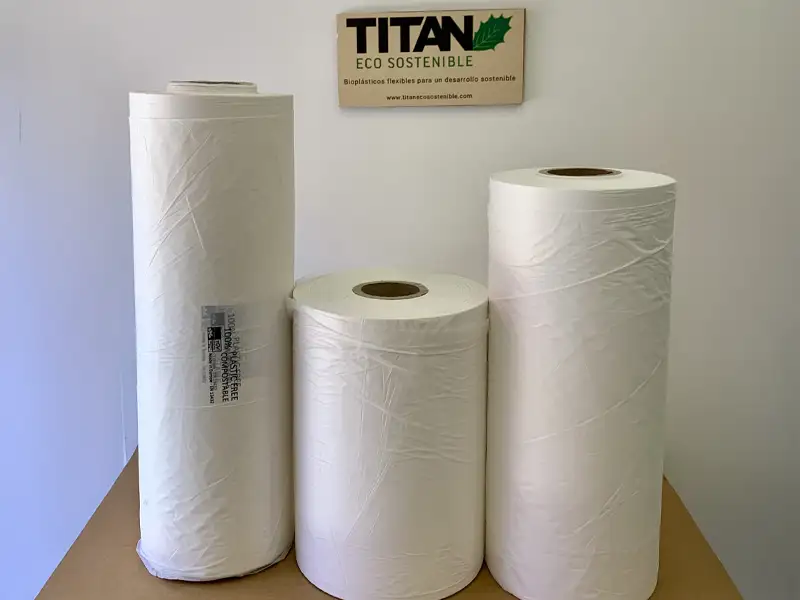
Flexible recycled plastic packaging is an innovative solution that efficiently replaces conventional plastics in a wide variety of applications. Thanks to its mechanical, barrier and sealing properties, its use extends to multiple sectors without compromising product functionality and safety to any extent.
Today, these films reel can be used in practically all existing product packaging solutions, including:
Today, these films reel can be used in practically all existing product packaging solutions, including:
- Fresh and processed eco-friendly food packaging: fruit packaging, vegetable packaging, bakery, snacks, 5th range and other mass consumer products, including vacuum packaging.
- Packaging industry generally: single-use pouches that meet protection and preservation requirements.
Thanks to its compatibility with current plastic machining and printing processes, the transition to compostable flexible packaging is simple, without the need for major changes to production lines.
This makes it a reliable, low-risk option for companies looking to reduce their environmental impact without compromising their operational efficiency.
Certifications
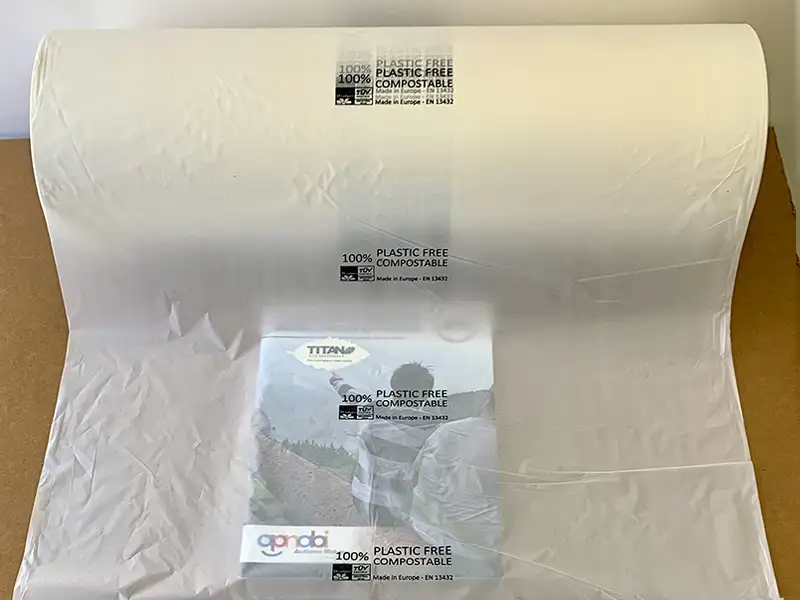
- Our films for compostable flexible packaging are manufactured in compliance with the European standard EN 13432 and are certified OK INDUSTRIAL COMPOST by TÜV AUSTRIA.
- This standard establishes the requirements that materials destined for the organic container must meet, mainly regulating the maximum biodegradation time and ensuring the absence of polluting chemical substances.
How long does it take for a compostable film to break down?
When disposed of in the compost garbage can, the material decomposes in approximately 3 weeks once the process is initiated in an industrial composting plant.
On the other hand, if it is left in nature, its biodegradation occurs in a period equivalent to 1% to 4% of the time needed for a conventional plastic of petrochemical origin.
Depending on the climatic conditions of the environment, this corresponds to a period of 3 to 5 years.
The advised storage periods before they start to lose mechanical properties depend on the type of biopolymer and can range from 1 to 4 years.
On the other hand, if it is left in nature, its biodegradation occurs in a period equivalent to 1% to 4% of the time needed for a conventional plastic of petrochemical origin.
Depending on the climatic conditions of the environment, this corresponds to a period of 3 to 5 years.
The advised storage periods before they start to lose mechanical properties depend on the type of biopolymer and can range from 1 to 4 years.
What are compostable films made of?
Compostable films are made from renewable natural resources such as starch, sugars, cellulose, food waste and can be produced by physical or biotechnological processes such as microbial fermentation with different biopolymers.
In which container should bio-plastic packaging be recycled?
In the brown garbage can or organic garbage can.
As they are compostable according to EN 13432, they can be disposed together with food waste, simplifying waste management and reducing the environmental impact of packaging.
It is subsequently transferred to a composting plant where it will be revalorized into compost for the soil.
What is the difference between biodegradable and compostable?
Biodegradation, is a natural degradation process and it is subject to the natural conditions of the site where the material has been deposited.
Degradation, by composting is an artificial process, consisting in favoring bacterial conditions to rapidly degrade the material.
It is important to realize that everything is biodegradable, since nature is capable of degrading any material over time.
Degradation, by composting is an artificial process, consisting in favoring bacterial conditions to rapidly degrade the material.
It is important to realize that everything is biodegradable, since nature is capable of degrading any material over time.
The time factor is what makes the difference in sustainability.